How We Moved to Lisbon: The Full Story
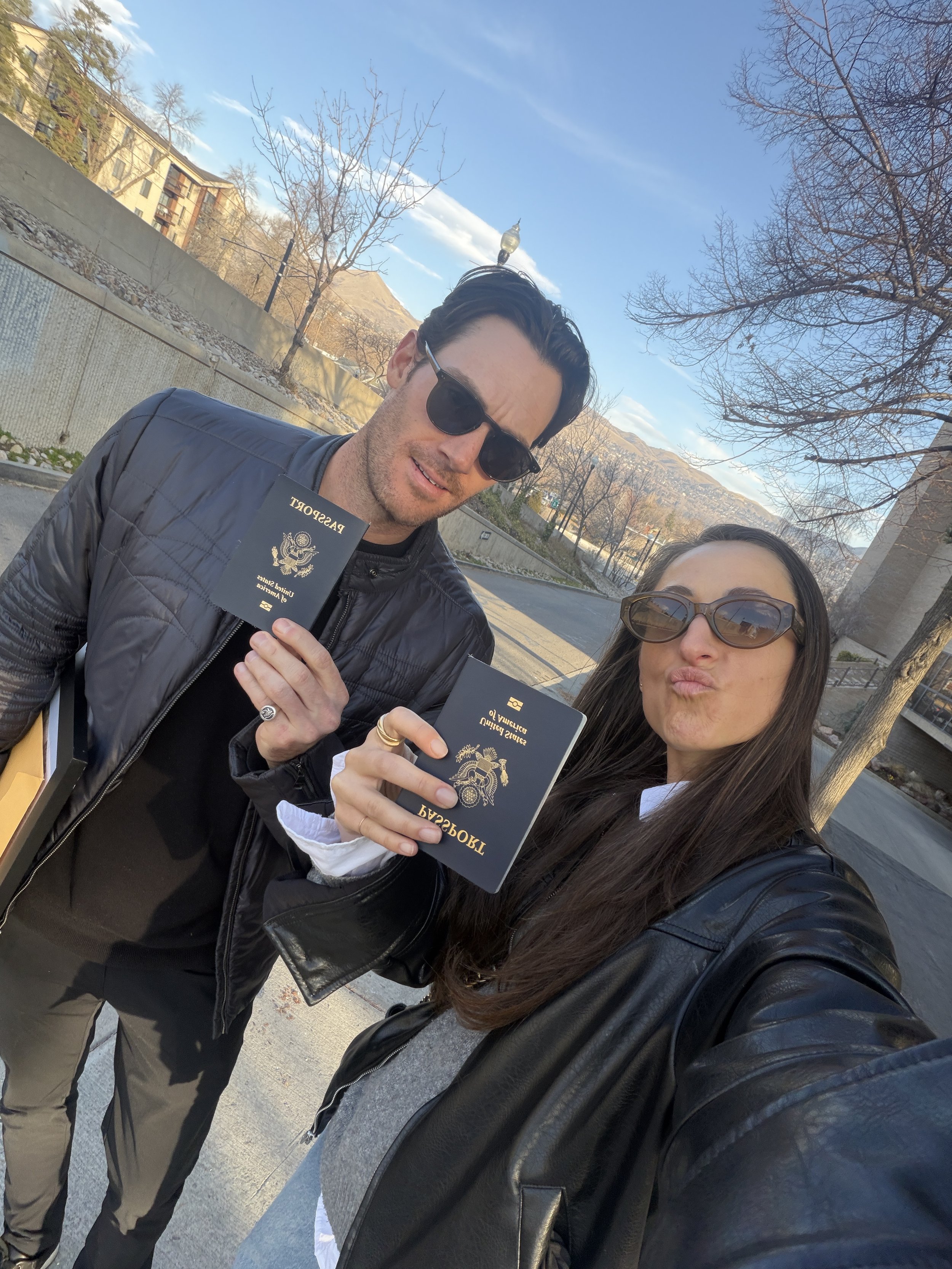

Hello friends and readers!
As many of you know, Greg and I embarked on the adventure of a lifetime and moved to Lisbon in February 2026.
The process was harder than I expected and involved a lot more moving pieces than either of us initially anticipated. So I thought it might be helpful to go through how it all actually happened. Not just the logistical side (visa requirements, application timelines, endless paperwork), but also some of the emotional aspects... the strain it put on our relationship, the months of living in limbo waiting for approvals that may or may not come through, and the mindset shifts on both our sides that made any of this possible in the first place.
If you've been considering an international move, whether alone or with a partner, hopefully some of this is helpful. Just keep in mind that everything I talk about here is specific to our situation and the visa requirements for Portugal, so it will of course be different for everyone. This isn't advice on what to do. It's more of an honest overview of our entire experience navigating this together.
This is going to be a long one, so grab a coffee and buckle up.
The Backstory
I did my master's degree in London in 2018, and one of my biggest regrets has always been not staying in the U.K. When I moved back to the U.S., I kept imagining a life where I'd eventually find my way across the pond back to Europe. But then COVID hit, borders closed, and that vision got pushed further and further away. And then I met Greg.
We talked about moving abroad over the years. He was open to the idea, but also hesitant. Greg is the stable to my chaos. I'm the one who wants to leap and figure it out on the way down. He's the one who wants a plan first. And honestly, we had very different dreams. Mine was to live abroad. His was to crush it in his career and own a home in the U.S. He didn't want to uproot our lives and move to a different continent, and I get it. Two very different visions for the future, and that's a hard thing to reconcile in a relationship.
So for a long time, I just kept wanting it. I spent years bringing it up, pushing for it, hoping something would shift. But I couldn't see how we would ever actually make it work, so the dream just sat there, unresolved.
My Internal Shift
Then in fall of 2025, I spent about two months traveling around Europe, staying with close friends in cities like London, Amsterdam, Zurich, and Paris. Somewhere during that trip, something in me finally shifted.
I realized that if I could just build a life where I got to spend a month or two in Europe every year, that would be more than enough for me (I mean, what a life!). I didn't need to live here full time to be happy. I could love Europe and still be genuinely content living in Salt Lake. So instead of shoving my dream down like I had done in the past, my dream changed shape because I finally felt at peace with where I already was.
I came home feeling good. We had a condo we owned. We had our routines. We had community. We had mountains and access to the outdoors! We lived in a place that really worked for us. Turns out letting go is the secret to manifesting, because within days of getting back from that trip, Greg found an MBA program in Lisbon.
Greg’s Internal Shift
We had talked about him going back to school for years. It had always been a potential path to Europe, but he was never fully on board. He was doing well at work. MBA programs can be expensive and it didn't make sense for him to walk away from his career just to pay for more school. But while I was away traveling, something had shifted for him, too. We had bought our condo in Salt Lake, which had been one of his dreams. He was already excelling in his career. He had achieved what he set out to achieve. And somewhere in that, he had his own realization: why not take the risk now, while we're young-ish and don't have kids?
I think this is really important to say clearly: in the end, this move was not something I convinced him to do. We both had our own internal shifts at the same time. I let go. He leaned in. And it couldn't have happened any other way.
If he hadn't genuinely wanted this, if I had forced it, there's no way it would have worked. The visa process alone was so stressful that I don't think our relationship would have survived if we weren't completely aligned. But because we both arrived at this moment on our own, in our own ways, suddenly years of me wishing and hoping and trying to get him on board just dissolved. He wanted it as much as I did.
That's part of why the whole thing felt so surreal. For years, this had been my dream. I had been the one pushing for it. Then I let go of it, and suddenly it became real through a completely different door.
Two Months to Uproot Everything - The Timeline
Once we decided to go for it, everything moved fast. Greg found the MBA program on a Tuesday and applied that same night. The next morning he had a call with the program advisor. By Friday he was accepted. The following Monday we had a call with an immigration lawyer (shoutout Carolina), and by Wednesday we had signed with her (you can find her info here, make sure to tell her I sent you <3). Thursday was Thanksgiving in the U.S. (late November). Keep in mind Greg’s program started in mid-January, so in the span of about two months, we had to figure out how to apply for visas, gather all of the required paperwork, get approved, rent out our condo in the middle of winter (not exactly prime rental season), sell most of our belongings, have Greg put in notice at work, and move to Portugal. And then actually set up a life once we got there.
When people ask how we did it, that's the short version. The longer version is that it was much more complicated and much more stressful than I ever expected. Not because moving abroad is impossible, but because we were on such an accelerated timeline that we had to make enormous decisions before we had any certainty that things were actually going to work out.
That was the part that caught me off guard the most. Not the paperwork or the logistics, although there were plenty of both. It was the fact that we had to start dismantling our life in Salt Lake before either of us had a visa in hand.
We rented out our condo before our visas were approved. We sold most of our belongings before our visas were approved. Greg paid a deposit for his MBA program before our visas were approved because he needed the acceptance letter from the school as part of the application. We hired a lawyer and paid legal fees before we knew whether any of it would actually work out.
There was a very real possibility that we could spend a lot of money, uproot our entire life, and still not get approved in time. That's the part I don't think people really talk about when they talk about moving abroad. The version you usually see online is the apartment, the cafes, the pretty streets, the "we moved to Europe" post. What you don't see is the period before that, where you're making expensive, irreversible decisions while trying to stay calm in the middle of a process that doesn't offer much clarity at all.
Once we had committed, it became a very hard lesson in surrender.
It was emotionally hard. It was stressful financially. And it was hard on the relationship, too. There were so many unknowns and so many chances for things to go sideways. A lot of trust was required, both in the process and in each other.
We really did work as a team through most of it. But toward the end, when the delays started piling up and we were living in limbo, that's when it became the hardest. But we'll get to that.
The Nuts and Bolts of the Visa
Because we're not married, we couldn't just apply as one married couple and be done with it. We had to apply for two separate visas. In the end, this may have actually been a blessing, because from what I've heard, the family reunification visa process can take a very long time. That's the route where one partner applies as the primary visa holder and the other applies as a dependent, and from what we were told, the dependent application often gets delayed or processed separately, which can leave couples in limbo for months. This is where it really helps to consult an immigration lawyer (again, here is our lawyer for reference).
Here's how we did it. Greg applied for a D4 student visa through his MBA program. The D4 is Portugal's student visa, designed for individuals enrolled in a university or accredited educational program. It requires proof of enrollment, financial means, health insurance, and a clean criminal record.
After speaking with our immigration lawyer, she recommended that I apply for a D7 visa, which is a passive income visa. Portugal introduced the D7 as part of its effort to attract foreign residents who can support themselves without working in Portugal, including retirees, remote workers, and individuals with passive income streams. In my case, this made sense because we owned a condo in Salt Lake and were planning to rent it out. That rental income counted as passive income, which allowed me to apply under this category. Side note: it doesn't matter if you still have a mortgage on the property. As long as you own your home and are receiving any money from a tenant, that qualifies as passive income.
Applying for two separate visas did add another layer of complexity because we didn't know whether our applications would move at the same speed or be approved at the same time. It wasn't just about whether we were getting approved. It was about whether we were both getting approved, and whether that would happen in time for Greg's program.
Another thing I didn't fully understand before going through this is how much needs to be done before you even get to the point of submitting the application.
Before we could apply, we needed to gather all of our individual financial documents, set up a Portuguese bank account, get a Portuguese tax identification number (called a NIF), sign a lease and secure a Lisbon address, get FBI background checks, get documents apostilled (more on that in a moment), and provide proof of our relationship. Plus a few other things.
Our lawyer helped with some of this setup, including the Portuguese bank account and the tax ID number, which was helpful because trying to figure that out on our own on such a short timeline would have been extremely difficult.
As I mentioned above, because we aren't married, we also had to show proof of our relationship. Since we were living in Utah at the time, we went to Salt Lake City and got documentation showing that we were partners. That became part of the application, and I actually think it was one of the most important pieces of paperwork we ended up submitting. If you're moving with a partner and you're not married, I cannot stress this enough: get official proof of your relationship, because it ties your applications together.
Every single one of these steps sounds manageable when you say them out loud individually. The difficulty is doing all of them at once, under pressure, with deadlines, while also trying to move out of your house and plan an international relocation. Not to mention Greg was still working full time through all of this. Plus, each one of these steps required further steps beneath it. This is just the simplified version of what happened, so keep that in mind.
FBI Background Check and Apostille
The thing that slowed us down the most was the FBI background check.
You don't just need the background check itself. It also has to be apostilled. An apostille is a special certificate that authenticates a document for use in foreign countries. Essentially, it validates the official's signature and seal, making the document legally recognized in other member countries of the Hague Apostille Convention without requiring further legalization.
To make it even more complicated, each individual state in the U.S. has a different process for how this works. So while I'll share how we did it, the steps may differ depending on where you live.
For us, that meant getting fingerprints done, getting the FBI background check processed, and then sending it to the federal government (specifically the U.S. Department of State) to be apostilled. That took weeks. It ended up being the longest part of the entire process and ultimately delayed our application.
If I could give one very practical piece of advice to anyone considering this process, it would be to start the FBI background check and apostille as early as humanly possible. It became the bottleneck for us, and by the end, everything revolved around waiting for that one document.
Visa Appointments in San Francisco
Another part of the process that was more complicated than I expected was the actual application submission. You don't go straight to the Portuguese consulate. There's an intermediary that handles intake, and for us, because we were living in Utah, that meant dealing with VFS Global in San Francisco. You're assigned a different city based on the region you live in, so make sure to check which one applies to you. VFS Global is a visa outsourcing company that processes applications on behalf of various governments around the world, including Portugal's.
So once we had all the paperwork mentioned above put together, we had to go to San Francisco. The problem was that there were no appointments available for months, and we obviously didn't have months. So we tried to move things along without an appointment because our situation was so time-sensitive. VFS takes student walk-ins on Monday mornings, so we decided to risk it.
That day was awful. First of all, because we were walking in, an appointment wasn't guaranteed. After waiting for over three hours, we finally got to see someone. But the VFS employee wouldn't accept our applications because our FBI documents were still pending (the bottleneck I mentioned earlier).
Here's where it gets even more frustrating. Our lawyer had actually gotten approval from the Portuguese consulate saying we could mail the FBI documents in after our applications were submitted, so we wouldn't hold up the process. We had this in writing. But the employee at VFS still wouldn't accept it. Because VFS is a separate entity from the consulate, they have their own rules, and our written approval from the consulate didn't matter to them.
We were so deep in the process by that point. We had spent weeks gathering documents and traveled to San Francisco just to get turned away over one piece that was already in motion. Greg is usually calm and easygoing, but that was the angriest I've ever seen him in our entire relationship. It was one of the hardest moments of the entire process.
So we had to leave without submitting. That delayed things by several weeks, which meant that in the end, Greg was a month late for school.
That was one of several moments where it really hit me how little control you actually have in a process like this. You can move quickly, you can organize well, you can overnight documents, you can spend money to speed things up where possible—and there are still parts that simply move at their own pace or that you have zero control over. It was extremely frustrating and humbling, and neither of us handled the day well.
When Things Got REALLY Hard
Eventually, we got our applications in. A few weeks later, we got confirmation that they had been approved by VFS and sent on to the Portuguese consulate in San Francisco. At that point, we thought we were basically done. We assumed that once they reached the consulate, approval was right around the corner.
That's not actually how it works.
What we hadn't fully understood was that there was another layer of approval through the Portuguese government itself. So there were effectively three levels in the process, and that meant more waiting than we had anticipated.
By that point, we had already rented out our condo. We had already sold most of our things. We were staying with a friend. We were living out of suitcases. We had no clear timeline for when we were leaving, and no one could really tell us when a decision would come through.
We were just in this strange in-between state where our old life was already packed up and gone, but the new one hadn't started yet. Greg was also already late to his MBA program, which added a whole other layer of stress. He was the only one in his cohort arriving late. We both knew that every extra week mattered.
That limbo period lasted about three and a half weeks, and it was by far the hardest part of the entire process and when the stress really started to catch up with us. We were tired, we were unsettled, and we had already made all of these huge commitments without a final answer. It's one thing to take a risk when everything still feels theoretical. It's another thing entirely when the risk has already become your daily reality.
As we waited in limbo, we started to bicker more than we had during the entire visa process. Moving fast and hustling had united us. Waiting around in the unknown with nothing to do but sit with the uncertainty? That's when things started to break down.
It definitely took a toll on the relationship. And honestly, if we didn't have a strong foundation, and if we didn't both want this so badly, I'm not sure how it would have played out. This is exactly why one person forcing the move never would have worked. We both needed to want it.
Eventually we realized that sitting around waiting and wallowing wasn't going to make the visas come any faster. So we booked a spontaneous trip to LA for a week and said screw it, let's just go have some fun. That mental shift was critical. We couldn't control the timeline, but we could control how we spent the time we had. That, plus the foundation we'd built over years together, is what carried us through.
What It All Cost (Financially)
By the end of the process, we had spent just over $4,000 on visa related costs alone. About $3,000 of that was legal fees and the rest was everything else that added up quickly: FBI fingerprints, apostilles, overnighting documents, the lease setup, getting to our visa appointment in San Francisco, and all the smaller administrative costs that come with a process like this.
Keep in mind that we also sold almost everything we owned. All of our furniture, both of our cars. That more than covered the visa costs. It also ended up covering our rental deposit once we got to Lisbon (which is two months rent upfront and two months as a deposit — that's standard here), plus most of the furniture to furnish a three bedroom apartment. So all in all, selling everything we had in the US covered the legal fees and most of our moving costs here. It ended up almost being an even split.
But there are hidden costs everywhere. Renting a U-haul to move the few things we didn't sell to Greg's parents' house. One way flights for two people. Checking two bags each at about $100 per person. And then there's the part no one really wants to think about: starting from scratch in a foreign country. Beds, couches, restocking your entire kitchen with cups and plates and forks. Cleaning supplies. Bathroom supplies. Decor. Plants. Lighting. Blankets. Chairs. Pens. Paper. The list goes on and on and on (and on).
It's not just a financial cost. It's a mental one. I knew we were "starting over," but I didn't actually understand what that meant until I was standing in an empty apartment realizing we had to rebuild everything from nothing. Worth it? Yes. Easy? Not even close. Just know what you’re signing up for!
Getting Approved and Finally Leaving
After weeks and weeks of waiting, we finally found out we were approved at the beginning of February. We happened to be visiting my sister in LA when the news came through. This was the trip I mentioned earlier, the one where we decided to stop obsessing, let go, and just have fun for a few days. Turns out we were approved while we were riding rollercoasters at Magic Mountain. We didn't find out until later, but looking back, it feels like a fitting reminder that things tend to work out the moment you stop white-knuckling them.
We assumed we'd have the visas in hand by the next day (you pay for an overnight label when you submit your application). We didn't actually receive them until Friday. Greg was already behind on his MBA program, so we had hoped to fly out Thursday so he could make it to class by Friday. That didn't happen. We flew out the following Tuesday, and he ended up being a full month late to his program, which was far from ideal, but keep in mind we still got our visas approved in record time (the process can take up to a year sometimes, if not longer). So even though he was late, I still consider us extremely lucky for getting approved as fast as we did.
And of course, arriving in Lisbon didn't mean the logistics were over. It just meant we were entering a new phase: moving into our apartment, getting settled, dealing with utilities, figuring out deliveries, navigating the banking system, and learning how to function in a completely different country. It was overwhelming at times (and still is), but also exciting AF. We were finally here. And somehow, through all the chaos and craziness, we did it. We had made our dream come true.
Final Thoughts
I think the reason I wanted to write this is because I know how easy it is to see the polished version of a move abroad and think that the process must have been relatively straightforward. For us, it was not.
It was exciting, yes. I am incredibly grateful it worked out. But it was also uncertain, expensive, administratively exhausting, and emotionally draining. The hardest part was having to move forward without certainty. Having to make real decisions, spend real money, and take real risks before we knew whether everything would actually line up.
That in-between period changed how I think about moves like this. From the outside, they can look aspirational. From the inside, they often look like paperwork, waiting, stress, and trying not to lose your mind while your life is temporarily suspended. It worked out for us, but it definitely was not the clean, seamless version people tend to imagine.
And now that we are here, we love it. But there are curveballs that come with living in a new country, things you cannot fully prepare for until you are in them. Learning new cultures, rhythms, and ways of doing things. Adjusting to a pace of life that is different from what you are used to. Things are done very differently here compared to the U.S., some things better, some things not so much.
We are still learning, growing, and adjusting. We are figuring out careers, navigating life together, and building something new from scratch. It is not like we got here and everything was picture perfect. It is still a struggle in many ways, but it is a struggle I would never give up. I am so grateful for this opportunity, for a chance to start a new life abroad, for the discomfort that comes with growth, and for the fact that we bet on ourselves even when nothing was guaranteed.
I have no idea what the future looks like, but I wake up every day grateful to even have the chance to be here.
If you are considering a move abroad and you have questions about the visa process, the logistics, or just what it is actually like to uproot your life and start over somewhere new, feel free to reach out. I am always happy to share what I have learned.
You can find me on Instagram at @stasianikova.
You can find our immigration lawyer, Carolina Sobrinho, here.